

Multi-Layer PCR Film Deinking Systems Market to Surge from USD 720 Million in 2026 to USD 2,532 Million by 2036 | FMI
Multi-Layer PCR Film Deinking Systems Market
USA demand for multi-layer PCR film deinking systems grow at 12.8% CAGR, driven by PCR target, recycling capacity expansion and scalable, high-uptime solutions.
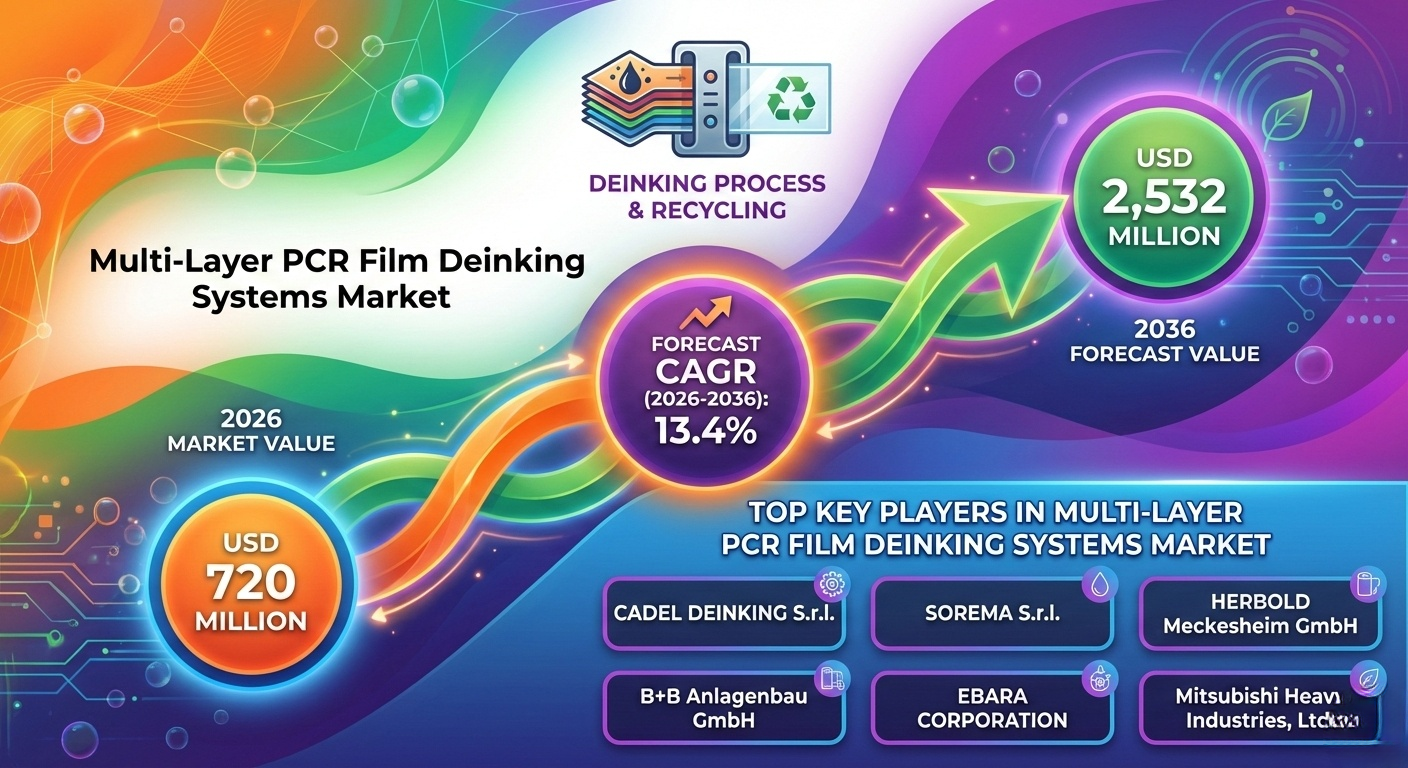
NEWARK, DE, UNITED STATES, January 28, 2026 /EINPresswire.com/ -- The multi-layer PCR (post-consumer recycled) film deinking systems market is entering a decisive growth phase as regulatory pressure, recycled-content mandates, and material recovery challenges reshape investment priorities across the circular plastics value chain. According to the latest market outlook for 2026 to 2036, the market is projected to expand from USD 720 million in 2026 to USD 2,532 million by 2036, registering a compound annual growth rate (CAGR) of 13.4%.
This growth reflects not just rising installation volumes, but a structural shift toward performance-led, capital-intensive deinking systems that deliver measurable improvements in PCR quality, yield, and compliance readiness. Value creation in the market is increasingly driven by operating cost reduction, ink-removal efficiency, and lifecycle economics, rather than lowest upfront equipment pricing.
Discover Growth Opportunities in the Market – Get Your Sample Report Now
https://www.futuremarketinsights.com/reports/sample/rep-gb-31329
Market Snapshot: Key Metrics at a Glance
• Market Value (2026): USD 720 million
• Forecast Value (2036): USD 2,532 million
• CAGR (2026–2036): 13.4%
• Leading System Type: Wet & Chemical Deinking Lines (43% share)
• Leading End Use: Flexible Packaging Recycling (45% share)
• Key Growth Regions: Asia Pacific, Europe, North America, Latin America, Middle East & Africa
Why Deinking Systems Are Becoming Central to PCR Film Recycling
The market’s momentum is closely linked to the growing complexity of post-consumer plastic waste streams. Multi-layer films used in food, personal care, and consumer goods packaging contain inks, adhesives, and barrier layers that limit recyclability and polymer purity. Deinking systems play a critical role in removing these contaminants, enabling recyclers to upgrade lower-grade film waste into usable PCR feedstock for higher-value applications.
Regulatory frameworks and brand-owner sustainability commitments are accelerating adoption. Governments and packaging producers are setting minimum recycled-content requirements for flexible packaging, shifting demand from discretionary recycling investments to compliance-driven system upgrades. As a result, deinking systems are now viewed as essential infrastructure rather than optional processing add-ons.
Performance, Integration, and Cost Control Shape Buying Decisions
Capital intensity remains high, with system pricing influenced by engineering depth, chemical efficiency, automation levels, and integration with washing and extrusion lines. Pricing power increasingly rests with suppliers that can demonstrate:
• Higher ink-removal efficiency and polymer purity
• Yield uplift and reduced reject rates
• Lower water, energy, and chemical consumption
• Compliance readiness for recycled-content mandates
Between 2026 and 2036, market value is expected to accrue disproportionately to technology providers offering modular scalability, proprietary process know-how, and long-term service contracts. Recyclers are prioritizing reliability and total cost of ownership as circular economy requirements tighten globally.
Market Structure by End Use and System Type
End Use Outlook
Flexible packaging recycling accounts for 45% of market demand, reflecting the dominance of multi-layer laminates in consumer packaging waste streams. These materials require advanced deinking to meet brand specifications for color, odor, and contaminant thresholds. Other end uses include food and non-food films, high-purity film recovery, large-scale film recycling, and emerging film recycling streams.
System Type Trends
By system type, wet and chemical deinking lines hold a 43% share, driven by their effectiveness in removing inks, coatings, and adhesive residues from complex film structures. Controlled chemical action combined with staged washing enables predictable, scalable outcomes while preserving polymer integrity. Modular deinking units, precision separation systems, and integrated wash lines support application-specific recovery goals and phased capacity expansion.
Regional Growth Patterns Highlight Diverging Investment Priorities
Growth trajectories vary by country based on recycling infrastructure maturity and regulatory enforcement:
• India (CAGR 15.6%) is the fastest-growing market, driven by Extended Producer Responsibility regulations and rapid development of flexible plastic recycling capacity. Demand emphasizes modular, affordable systems compatible with heterogeneous waste streams.
• China (CAGR 14.8%) represents a volume-led market, supported by new recycling parks and policy mandates on plastic waste reduction. Buyers prioritize throughput, scalability, and cost efficiency.
• United States (CAGR 12.8%) growth is fueled by brand commitments to PCR content and expansion of domestic recycling hubs, with procurement focused on scalability, uptime, and lifecycle costs.
• Germany (CAGR 12.4%) is upgrade-driven, shaped by strict circular economy regulations and high-quality expectations, favoring engineered, specification-intensive deinking systems.
• Japan (CAGR 10.6%) applies precision recycling principles, emphasizing energy efficiency, process repeatability, and long-term operational reliability over rapid capacity expansion.
Competitive Landscape: Engineering Depth Over Price Competition
Competition in the multi-layer PCR film deinking systems market centers on process efficiency, separation quality, and documented throughput performance. Suppliers such as CADEL DEINKING S.r.l., SOREMA S.r.l., HERBOLD Meckesheim GmbH, B+B Anlagenbau GmbH, EBARA CORPORATION, and Mitsubishi Heavy Industries, Ltd. differentiate through official product literature highlighting engineered washing stages, modular architectures, automation, and integration capabilities.
Across the market, competitive advantage is defined less by equipment price and more by verified performance outcomes, system flexibility, and ability to support recyclers’ compliance and yield objectives.
Outlook: Deinking Systems as a Profit Pool Within Circular Plastics
As recycled-content mandates tighten globally, the ability to convert complex multi-layer films into compliant PCR materials is emerging as a critical growth lever. Over the 2026–2036 period, performance-led deinking technologies are expected to capture a disproportionate share of profit pools within the circular plastics value chain, reinforcing the strategic importance of multi-layer PCR film deinking systems for recyclers, packaging producers, and equipment suppliers alike.
Why FMI: https://www.futuremarketinsights.com/why-fmi
Have a Look at Related Research Reports on the Packaging Domain:
Digital Textile Printing Market https://www.futuremarketinsights.com/reports/digital-textile-printing-market
High-Barrier PCR Packaging Film Market https://www.futuremarketinsights.com/reports/high-barrier-pcr-packaging-film-market
Bag Closure Clips Market https://www.futuremarketinsights.com/reports/bag-closure-clips-market
Bamboo Straw Market https://www.futuremarketinsights.com/reports/bamboo-straws-market
About Future Market Insights (FMI)
Future Market Insights, Inc. (FMI) is an ESOMAR-certified, ISO 9001:2015 market research and consulting organization, trusted by Fortune 500 clients and global enterprises. With operations in the U.S., UK, India, and Dubai, FMI provides data-backed insights and strategic intelligence across 30+ industries and 1200 markets worldwide.
Sudip Saha
Future Market Insights Inc.
+1 347-918-3531
email us here
Legal Disclaimer:
EIN Presswire provides this news content "as is" without warranty of any kind. We do not accept any responsibility or liability for the accuracy, content, images, videos, licenses, completeness, legality, or reliability of the information contained in this article. If you have any complaints or copyright issues related to this article, kindly contact the author above.
